




Lower ash content in core stock extends log saw blade life and reduces production downtime
A case presented at Tissue Summit North America 2026 showed that reducing ash content from 6.5% to 3.5% increased the number of cuts per blade from 2.5 million to 5.6 million, recovering production hours and reducing maintenance requirements
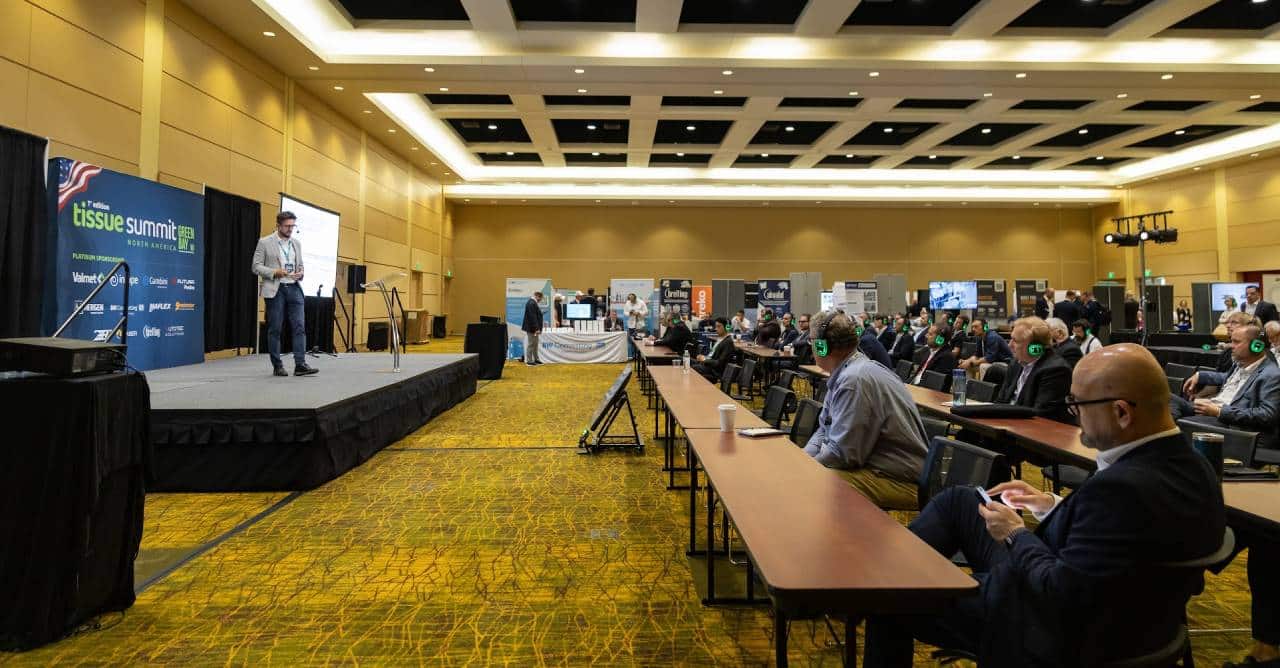
A question raised during Tissue Summit North America 2026 highlighted an often-overlooked factor in tissue converting operations: the ash content of core stock. According to the presenter, most converters do not have this information readily available, despite its direct impact on equipment performance and maintenance costs.
In the United States, most core stock has an ash content ranging from 6% to 8%. This is largely due to the structure of the supply chain. Much of the material comes from surplus paper generated by mills producing board for boxes. When these packaging manufacturers convert their excess production into core stock, there is little incentive to remove the ash content.
As a result, much of the core stock available in the United States and Europe has relatively high ash levels, with packaging companies supplying the material rather than specialized core stock manufacturers focused exclusively on this product.
The impact becomes particularly evident in log saw operations. Replacing a log saw blade takes between 40 and 45 minutes, and some production lines require a blade change every day. According to the presenter, mills using core stock with 3.5% ash can typically operate for five to seven days without stopping production for a blade replacement.
BRAZILIAN CASE DEMONSTRATES PRODUCTIVITY GAINS
The presentation included a case study from Brazil involving a Valmet Constellation S8 line operating with 100% virgin pulp.
Using standard core stock with 6.5% ash, the line achieved 2.5 million cuts per log saw blade. After switching to core stock with 3.5% ash, the number increased to 5.6 million cuts, representing an additional 3.1 million cuts per blade.

The improvement was achieved without changing the blade type, paper type or grammage. Further tests using core stock with 2.5% ash have reached 8 million cuts per blade.
From a total cost of ownership perspective, the presenter estimated that the change could recover 61 hours of production, equivalent to approximately 2.5 additional days of output per line, while eliminating the need for 81 blade replacements.
The audience was invited to calculate the financial impact based on the value of one hour of production at their respective facilities.
OPERATIONAL SAFETY ALSO AT STAKE
Beyond the financial and productivity benefits, the presenter highlighted the safety implications of reducing the frequency of blade changes.
Changing a log saw blade was identified as the highest-risk task on a converting line because of the exposure involved in the procedure. At mills operating with a single maintenance team, as many as four employees may be dedicated exclusively to changing log saw blades every day.
Reducing the frequency of these interventions can therefore also decrease employees’ exposure to one of the most hazardous maintenance activities in tissue converting operations.