



Canfor Corporation reported an operating loss of CAD 76.6 million and a net loss attributable to shareholders of CAD 88.2 million in the third quarter of 2026. The net loss was equivalent to CAD 0.75 per share.
Adjusted EBITDA reached CAD 98.1 million, down from CAD 119.6 million in the previous quarter. However, this was an improvement compared with the adjusted EBITDA loss of CAD 13.7 million recorded in Q3 2025.
Sales totalled CAD 1.28 billion between July and September, compared with CAD 1.53 billion in Q2 2026 and CAD 1.26 billion in the same period last year.
Reported EBITDA was CAD 24 million, compared with CAD 100.8 million in the previous quarter and a loss of CAD 110.7 million in Q3 2025. The company also reported an operating loss, following an operating profit of CAD 4.8 million in Q2.
PULP AND PAPER PERFORMANCE
Canfor’s pulp and paper segment recorded an operating loss of CAD 44.6 million, compared with CAD 23.1 million in Q2.
After accounting for CAD 38.4 million in adjustments and one-time items, adjusted EBITDA reached CAD 1.5 million. This compares with a loss of CAD 12.2 million in the previous quarter. Paper EBITDA also improved, rising from CAD 8 million to CAD 10.5 million.
Higher pulp and paper production supported the results. Output increased following scheduled maintenance work in the previous quarter. However, slightly lower US-dollar list prices for northern bleached softwood kraft (NBSK) pulp in China partially offset these gains.
Average NBSK list prices in China stood at USD 645 per tonne, down USD 13, or 2%, from Q2.
Global softwood pulp demand remained weak. Structural changes in the market and high producer inventories continued to put pressure on prices. Supply constraints, however, helped limit further declines.
At the end of August, producer inventories reached 46 days of supply. This was two days above June levels and close to the upper end of the 39-to-47-day range generally considered balanced.
Meanwhile, kraft paper demand maintained its positive momentum. In North America, consumption benefited from growing demand for paper-based packaging, higher plastic raw material costs and the replacement of plastic products with paper alternatives. Stronger demand for food packaging also supported the market.
FACILITY CLOSURES AND ONE-TIME ITEMS
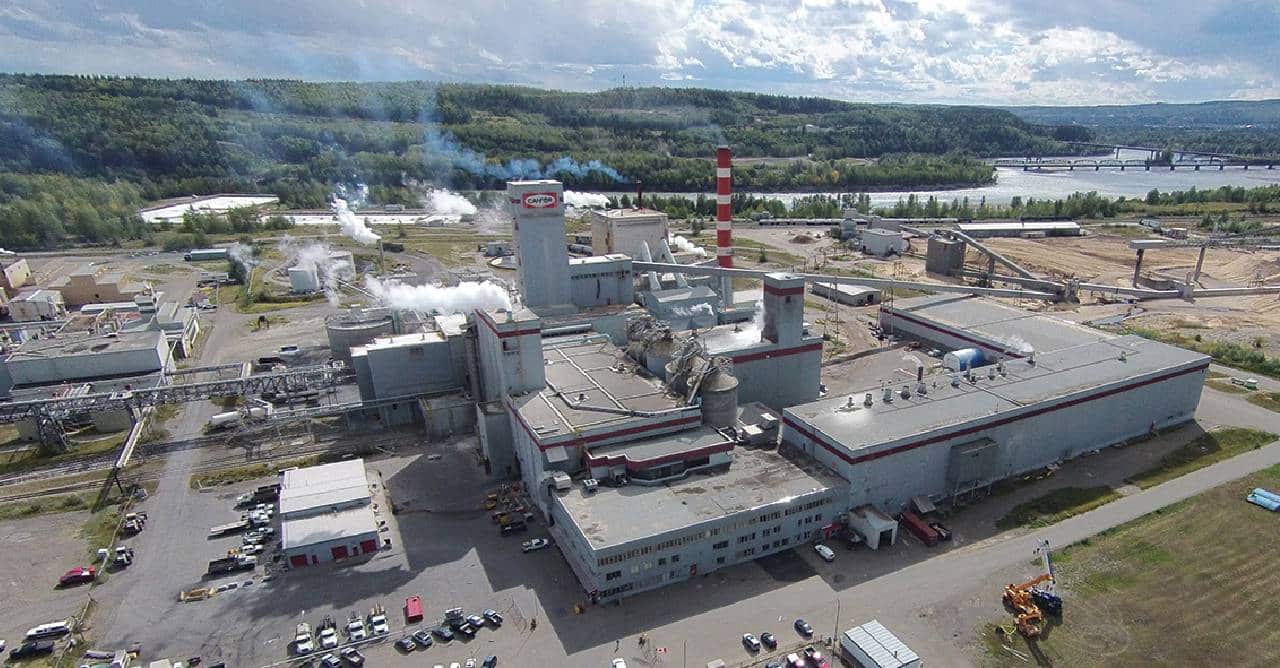
During the quarter, Canfor announced the permanent closure of two facilities: the Fox Creek sawmill in Alberta and the Northwood NBSK pulp mill in Prince George, British Columbia.
Fox Creek operations were wound down in September. Northwood is expected to close by the end of 2026.
The Fox Creek closure resulted in CAD 31.8 million in asset write-downs and impairments, as well as CAD 4.6 million in restructuring and closure costs. At Northwood, Canfor recorded CAD 10 million in asset impairments and CAD 36.7 million in restructuring and closure costs.
Total adjustments and one-time items reached CAD 74.1 million. This amount included the reversal of CAD 9 million in inventory write-downs, comprising CAD 700,000 in lumber and CAD 8.3 million in pulp and paper.
Adjusted operating loss totalled CAD 43.8 million, compared with an operating profit of CAD 14.8 million in Q2 and a loss of CAD 188.5 million in Q3 2025.
Before one-time items, the adjusted operating loss was CAD 2.5 million. This compares with a profit of CAD 23.6 million in the previous quarter and a loss of CAD 111.3 million a year earlier.
The third quarter of 2025 also included CAD 77.2 million (USD 56.2 million) in duties following the finalization of sixth-period review rates. No equivalent final duty-rate adjustment was recorded in Q3 2026.
The seventh-period countervailing and anti-dumping rates were finalized after the end of the quarter. As a result, CAD 45.9 million (USD 32.8 million) in expenses will be recognized in Q4 2026.

LUMBER MARKETS AND ACQUISITION
Canfor’s lumber segment recorded an operating loss of CAD 19.9 million, compared with an operating profit of CAD 41.2 million in Q2.
After CAD 35.7 million in adjustments and one-time items, adjusted EBITDA reached CAD 107.9 million, down from CAD 144.7 million in the previous quarter.
Results were relatively stable across the company’s operating regions. Lower shipments in Europe, mainly due to normal summer downtime, contributed to the quarterly decline. This was partly offset by higher shipments in the US South and improved sales prices across all regions.
During the quarter, Canfor also completed the acquisition of PinkWood, expanding its capacity in engineered wood products.
In North America, high mortgage rates and political and economic uncertainty continued to limit demand. Customers remained cautious with purchases and kept inventories low. Benchmark lumber prices declined slightly, although prices for wider dimensions improved. Demand from the repair and remodelling sector remained broadly stable.
In Japan, prices remained relatively stable. However, weak domestic demand and the growing use of domestic wood species reduced softwood lumber imports. In China, weak residential construction and ongoing challenges in the property market continued to weigh on demand.
Market conditions also varied across Europe. Central European prices remained stable, while favourable weather and stronger demand supported Northern Europe. In the United Kingdom, weak construction activity and ample supply put pressure on prices.
Demand and prices in the Middle East and North Africa remained stable despite geopolitical tensions.
Canfor President and CEO Susan Yurkovich said relatively stable lumber earnings, improved pulp performance and another strong quarter in paper supported the company’s results.
She also noted that challenging market conditions are expected to continue through year-end, with seasonal weakness in lumber and ongoing pressure on global pulp markets.
According to the company, the announced closures are part of its strategy to align its operations with market conditions and strengthen its resilience and competitiveness.
NINE-MONTH RESULTS
From January to September 2026, Canfor reported sales of CAD 4.17 billion, compared with CAD 4.06 billion in the same period of 2025.
Reported EBITDA reached CAD 153.3 million, reversing the loss of CAD 187.1 million recorded a year earlier. The operating loss also narrowed, falling to CAD 144.3 million from CAD 488.2 million.
Adjusted EBITDA increased to CAD 226.2 million, compared with CAD 113.6 million in the first nine months of 2025.
Adjusted operating loss totalled CAD 121.5 million, down from CAD 271.4 million. Before one-time items, the adjusted operating loss was CAD 71.4 million, compared with CAD 187.5 million a year earlier.
The net loss attributable to shareholders reached CAD 178.8 million, or CAD 1.53 per share. In the same period of 2025, the company reported a net loss of CAD 406.2 million, or CAD 3.45 per share.
Amortization totalled CAD 297.6 million, compared with CAD 301.1 million in the previous year.
The company also reported changes in impairment charges, inventory adjustments and restructuring costs across its lumber and pulp operations.
OUTLOOK
Canfor expects softwood kraft pulp markets to remain challenging through the end of 2026. New production capacity, weak demand and economic and geopolitical uncertainty are expected to limit purchasing activity and keep inventories high. These factors may also restrict price recovery.
Recent and potential additional supply reductions could help ease some of the pressure.
Demand for bleached kraft paper is expected to remain stable worldwide and in North America, supported by packaging applications.
Fourth-quarter results will reflect the closure of the Northwood mill, including its effects on production, shipments and costs. No major maintenance outages are scheduled for the remainder of 2026.
In North America, lumber markets are expected to weaken as construction activity slows seasonally and underlying demand remains subdued. High mortgage rates, affordability challenges and cautious purchasing are expected to continue into 2027.
Lower softwood lumber duty rates, effective from mid-October, are expected to partly offset weaker Western SPF pricing.
In Japan, demand and prices may improve as delayed projects move forward and manufacturing activity picks up. Chinese demand, however, is expected to remain weak.
In Europe, prices are expected to decline slightly. Pressure in the United Kingdom may also spread to Central Europe, while Northern Europe and Middle East and North African markets are expected to remain relatively stable.
Canfor’s non-IFRS financial measures are defined by the company and may differ from similarly named measures used by other businesses. Its outlook is also subject to market conditions and other risks.
The company’s results presentation and webcast replay are available through its investor relations materials, with replay access scheduled to remain available until January 5, 2027.
Headquartered in Vancouver, Canada, Canfor manufactures lumber, engineered wood products, pulp, paper, pellets and green energy. The company operates more than 50 facilities across Canada, the United States and Europe. It also owns a 77% stake in Swedish company Vida AB and is listed on the Toronto Stock Exchange under the ticker CFP.