



The challenges facing the tissue industry in Europe
In Lucca, global leaders mapped out the structural pressure reshaping the European tissue market: rapidly rising Asian imports, energy costs at a competitive disadvantage, declining demographics and an industry calling for regulatory reciprocity

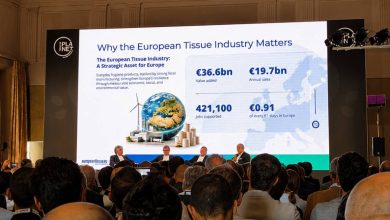
Tissue Planet 2026, organized by Toscotec in Lucca, made it clear that the European tissue industry is going through its sharpest reconfiguration in two decades. Carlos Reinoso, Chairman & Director General of the European Tissue Symposium (ETS), presented the first comprehensive socio-economic study of the sector: European tissue generates 36.6 billion euros in added value, 19.7 billion in annual sales and sustains more than 421,000 jobs on the continent, with 0.91 euro of every 1 euro spent by consumers staying in Europe. The study also modeled that a full migration of European public restrooms to paper towels could prevent up to 9.8 million flu infections per year, generating 1.47 billion in productivity gains and 16.4 billion in additional public revenue.
The pressure, however, is structural. Volker Zöller (Essity) warned that energy costs in Europe today are around 150% of those in China and 350% of those in the US, with direct consequences for scale economics. “We are not against regulation. We want fair regulation, with a level playing field for those who already comply with strict rules on sustainability, forest certification, emissions and traceability,” he said. Martin Krengel (Wepa Group) reinforced that the 48,000 direct jobs in the European industry, equivalent to entire mid-sized cities, depend on local production, communities and long-term trust.
The most pointed diagnosis came from Luigi Lazzareschi (Sofidel). Today, more than 52% of group revenue comes from the United States, in a market with no overcapacity, a concentrated customer base, one language and one set of regulations. Europe is the opposite, with fragmented retailers and an industry that, according to him, “installed too many machines over the last 20 years.” He rejected the idea of a “new normality” and pointed to double pressure: structurally, demographic change (more than 1 million births in Italy in 1963; fewer than 400,000 last year) and an ageing population; cyclically, raw material volatility, inflation, gas costs and growing friction with retailers. “There will be no new normality. The industry is suffering structurally in the long term.”
Philipp Jaki (Fastmarkets) sized up the rise in Asian imports: volumes into Europe rose from around 142,000 tonnes in 2022 to approximately 340,000 in 2025, more than doubling in the period. In parallel, the production cost gap between Asia and Europe widened to around USD 300 per tonne, while freight for a 40-foot container dropped from over USD 10,000 in 2022 to about USD 3,000. Europe relies on natural gas for around 84% of tissue production, with Italy, Austria and Belgium among the most exposed. Lazzareschi and Zöller converged on the trigger: US tariffs did not close down factories in Asia, they redirected flows toward Northern Europe. Lazzareschi added that EUDR, if properly implemented alongside the existing rules on sustainability, forest certification and traceability, would already be enough to make many unfair imports unviable.
Looking at the European market from the outside, Luís Bueno (Suzano) identified five distinctive features that help explain the moment: capacity concentrated in few players, supply hubs such as Lucca, energy and logistics as a competitive disadvantage, mounting import pressure and sustainability as a differentiator that should be turned into a competitive lever rather than a burden. Bueno also pointed out that European private label, without parallel in other regions, has relevant consequences for pricing and innovation across the sector. As a strategic recommendation, Jaki suggested labeling product origin clearly and repositioning the storytelling around origin and sustainability, in parallel with firmer political engagement in Brussels. By 2040, China and North America will account for around half of global tissue consumption, and Europe, at best, is expected to remain stable.
The convergence among speakers was clear: the way forward requires effective enforcement of existing rules (EUDR, ETS, sustainability certifications), competitive repositioning of European sustainability as an argument of origin, and strategic adaptation to the new demographic and energy cycle. The window is narrow, and the consensus was that conditions will not improve by inertia.