Metsä Tissue invests in sustainable transport of its products
The company started to use renewable fuels in transport of its tissue brand Lambi in Sweden
For Metsä Tissue, a part of Metsä Group, continuous improvement across the entire value chain is essential for sustainability. According to the company, its objective is to contribute to people’s well-being and to strive to minimize the environmental impacts of operations and products throughout their entire life cycle – from sourcing of raw materials to production and delivery to customers.
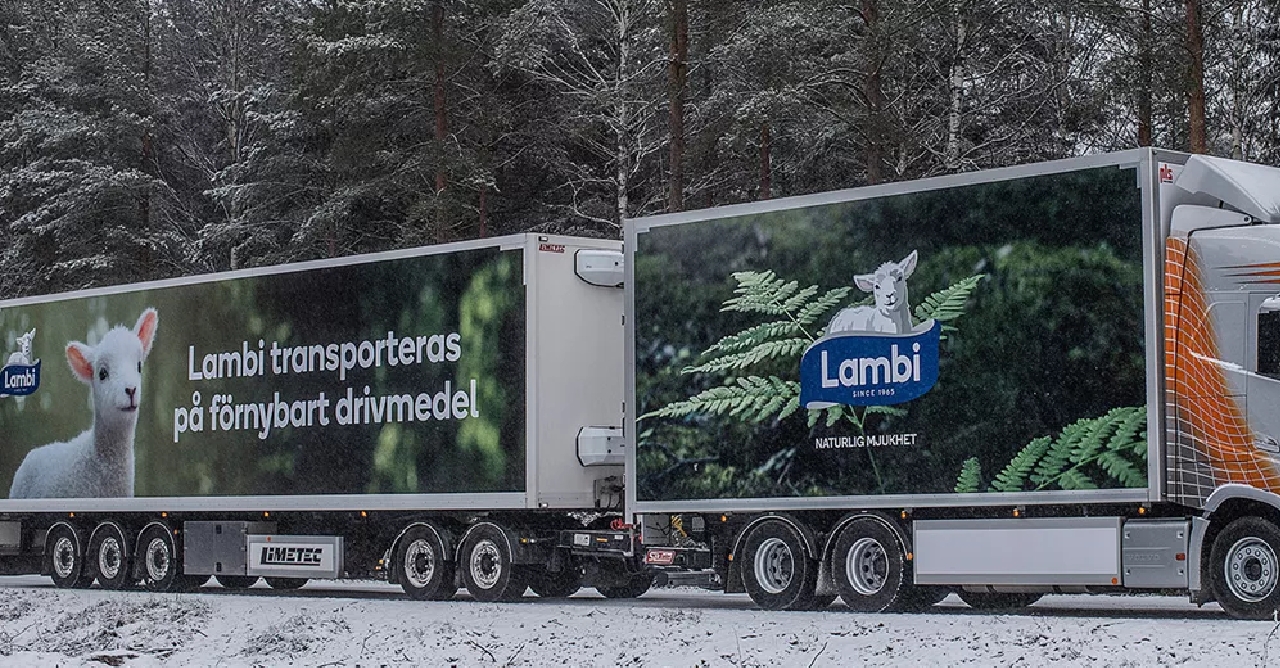
As one of its strategies to make its process more sustainable, the company announced that since the beginning of the year Lambi, one of its consumer tissue brands, has started using a renewable fuel driven truck in one of its transport routes in Sweden from the beginning of the year. This enables a reduction of 90% in greenhouse gas emissions per each truckload transported with renewable fuels.
Metsä Tissue utilizes fresh wood fibers as the main raw material in Lambi tissues to enable efficient tissue paper production. Additionally, transportation plays an important role in the sustainable value chain and therefore the reduction of CO2 emissions during transportation is of high priority for the company.
The Lambi branded biofuel truck runs on renewable diesel (HVO) which has a reduction in greenhouse gas emissions of as much as 90% in comparison to fossil-based diesel. The new biofuel driven Lambi truck enables achieving an annual reduction of 120 tons of CO2 emissions. This equals to a passenger car driving 700’000 km, or almost 18 laps around the globe.
“For Lambi, caring for the environment means, among many other things, delivering products in an environmentally conscious way. This route is our first step in Sweden and we are taking actions to increase the amount of routes when suitable transport capacity becomes available,” says Katariina Kukkonen, Marketing Director, Nordics.
“It is important to offer sustainable choices of tissue products and make the actions on sustainable development visible. This way we can help consumers to contribute to a more sustainable future by filling their shopping carts with sustainably produced, local products. Lambi products are a good example of this,” continues Kukkonen.