



Technology and AI pave the way for a new generation of tissue mills
In Lucca, suppliers, producers and consultancies showed that AI applied to operations, profitable decarbonization, fiber engineering and integrated design are already delivering measurable results, with less water, less energy and greater operational autonomy
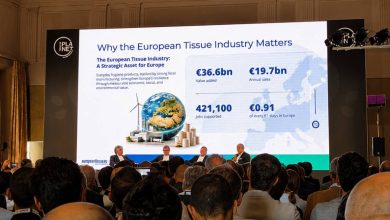
If the commercial reading of Tissue Planet 2026, organized by Toscotec in Lucca, shows a European industry under pressure, the technological reading is clearly optimistic. Over two days, machine suppliers, integrated producers and consultancies detailed a set of responses already in operation, with positive IRR and consistent efficiency gains. The common thread across the presentations was the shift from promises to cases with real, measurable results.
The ethical framing came from Mariarosaria Taddeo, Professor of Digital Ethics and Defence Technologies at the Oxford Internet Institute. “AI is not a replacement for talent,” she said, proposing that “trust is a form of delegation without supervision; when we delegate to a machine, we forget that we are still responsible.” The definition opened the way for Andreas Endters, President & CEO of Voith Paper, who showcased the next generation of the technology, capable of operating with 95% less water and more than 40% less energy, and detailed the MillOne suite, developed with IBM, which applies AI to the data layer the company calls “dataPARC.” Around 1,200 recognition and monitoring systems are already running in the field, with efficiency gains between 10% and 20%, supported by four data centers, one on each continent, connecting engineers and scientists to mill teams.
In fiber engineering, Darryl Holt (UPM Pulp) opened with the observation that tissue is the only paper segment growing toward 2040 (around 8 million additional tonnes globally), while pulp capacity additions over the last 10 to 15 years have been dominated by hardwood, making softwood progressively scarcer. In a TAD pilot, softwood content dropped from 60% to 35% while preserving strength, bulk and absorption, with savings of 8.5% per tonne; at industrial scale, on a double-width machine, 50% of softwood was replaced with birch in a kitchen towel grade, preserving all key metrics. Holt also flagged the physical limits of substitution, especially in embossing, and shared a real-world case where moving from a high-intensity refining plate to a 1.5/2.5 plate at 0.6 edge load brought softwood from 40% down to 20%.
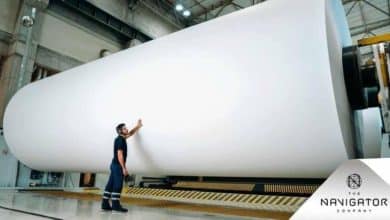
On decarbonization, Nuno Santos (The Navigator Company) presented four concrete actions enabled by integration with pulp operations: a steam turbine fed by biomass boilers, a new biomass boiler in Vila Velha de Ródão replacing natural gas in steam generation for the Yankee, Toscotec TT SteamBoosters recovering heat from hood exhaust, and rooftop solar plants. The company has already delivered 42% of its target to reduce ETS-covered emissions by 86% by 2035, and among 20 Iberian and French tissue producers, it is the one delivering finished products with the lowest emissions footprint (FisherSolve). “Every investment must have a positive IRR,” he said. Eduardo de Almeida (AFRY) reinforced the argument with the optimal investment curve, plotting decarbonization rate against IRR: in cases analyzed by the consultancy, projects can reach 50% decarbonization with IRR above baseline. He cited Spain as a glimpse of the future of European grids, suggesting that tissue mills able to modulate consumption will be rewarded for flexibility.
Olli Härkönen (Essity) brought the supply chain dimension, a blind spot for many companies: at the multinational, direct operations account for around 8% of total emissions, meaning most of the challenge lies in Scope 3. Since June, the company has operated its first plant entirely free of fossil fuels. “We do not rely only on technology or on capital. We rely on the people who execute the strategy every day.” Peter Oksakowski (BHM INGENIEURE) reminded the audience that around 50% of the capex of a new mill goes into buildings and infrastructure, and that integrated design can deliver up to 20% capex reduction, up to 25% opex savings, up to 25% in building energy consumption and up to 40% in life-cycle cost. “Process and intralogistics must drive layout, not the other way around.” Elena Troia (EuroVast) closed the technical front with the trajectory of the family group, which installed the first TT SYD (Steel Yankee Dryer) in the world and, after more than 20 years of operation, is already preparing the second generation of the technology, with a science-based target to reduce Scope 1 and Scope 2 by 42% in ten years.
The technical reading of Tissue Planet 2026 confirms that the technologies that will define the next ten years of the industry are no longer isolated experiments, but cases in operation with measurable returns. The frontier is no longer about choosing between technology, sustainability and competitiveness, but about designing projects in which these three dimensions advance together, site by site and on a life-cycle horizon.